
Why Most Strategies Fail Before Execution Even Begins
Why strategies fail is rarely about effort or execution—it’s about decision design, incentives, and systems that quietly break long before anyone takes action.
Most strategies don’t fail because people didn’t work hard enough.
They fail because the strategy was already broken—quietly, politely, and structurally—long before anyone tried to execute it.
Execution just takes the blame.
This is uncomfortable, because execution is where we point when we want a fix that doesn’t require rethinking how decisions were made in the first place.
But if strategies failed due to effort, more hustle would have solved this by now.
It hasn’t.
The Execution Myth (A Comfortable Lie)
When a strategy fails, organizations tend to say things like:
-
“We didn’t align the teams.”
-
“There were communication issues.”
-
“We need better accountability.”
-
“People resisted change.”
These explanations feel productive. They sound managerial. They also dodge the real problem.
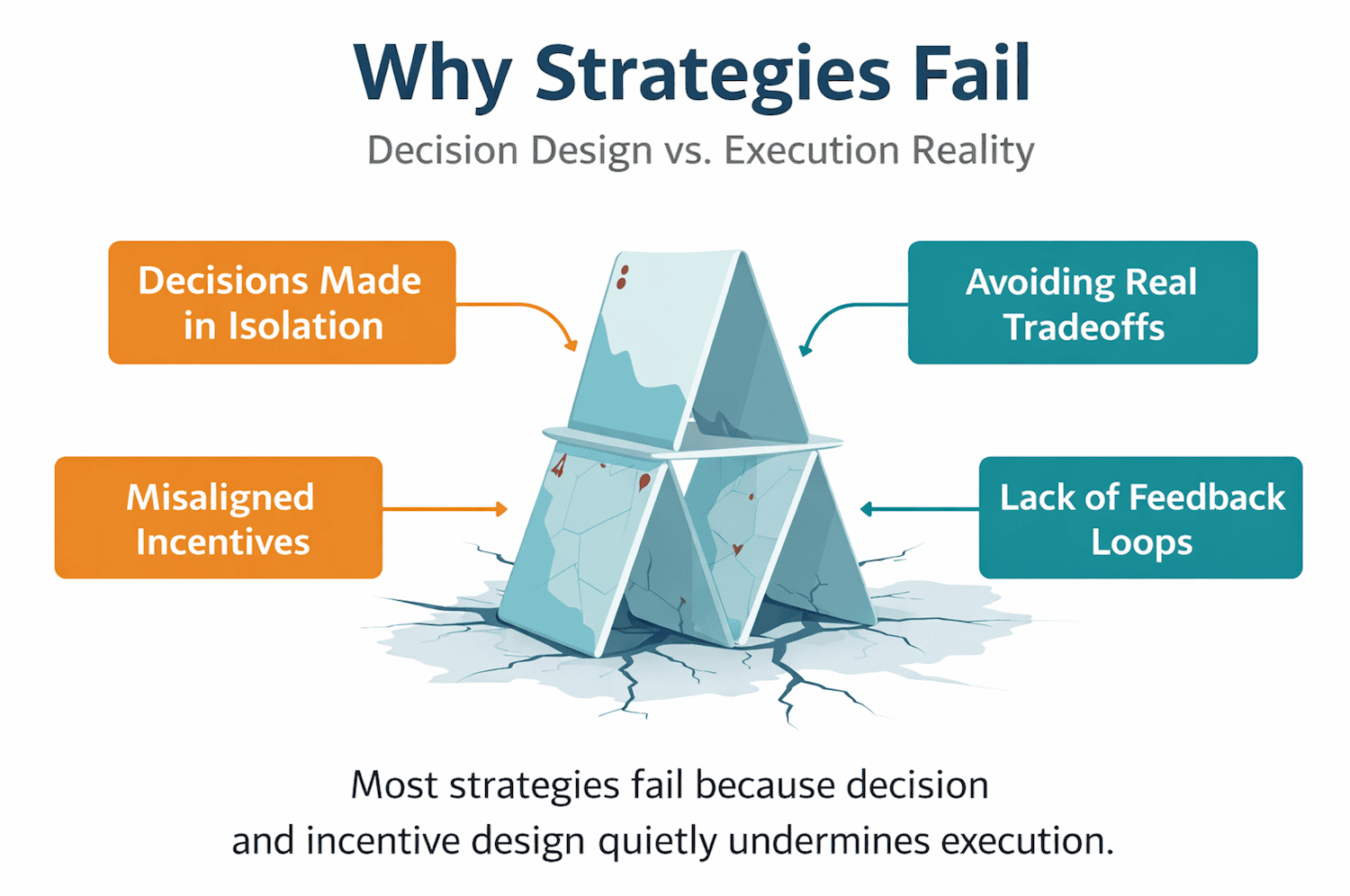
Most strategies fail upstream, at the point where:
-
assumptions go unchallenged
-
incentives are misaligned
-
tradeoffs are avoided
-
and decisions are made in isolation
By the time execution begins, the outcome is often already determined.
Execution doesn’t reveal whether a strategy is good.
It reveals whether the system was honest.
Strategies Fail When Decisions Are Made in Isolation
A common pattern:
Leadership defines a strategy.
Departments interpret it locally.
Teams optimize for what they’re measured on.
Everyone thinks they’re doing the right thing.
The system does exactly what it was designed to do—just not what anyone intended.
Why? Because strategy isn’t a document. It’s a decision architecture.
If decisions aren’t designed to work together, execution simply amplifies fragmentation.
You don’t get alignment by announcing alignment.
You get it by designing decisions that cannot succeed independently.
Incentives Don’t Support Strategy — They Replace It
Here’s an uncomfortable truth:
Incentives beat strategy every time.
If your strategy says “collaboration” but rewards individual performance, you didn’t design collaboration—you designed competition with nicer language.
If your strategy says “long-term value” but promotions reward short-term wins, your system already chose its priorities.
People aren’t failing your strategy.
They’re following the incentives perfectly.
And the more competent your team is, the faster this misalignment shows up.
Most Strategies Avoid Real Tradeoffs (And Pay for It Later)
Another quiet failure point: strategies that promise everything.
-
Growth and efficiency
-
Speed and control
-
Innovation and zero risk
These aren’t strategies. They’re wish lists.
A real strategy makes enemies.
It says no—clearly, visibly, and repeatedly.
When tradeoffs aren’t explicit, teams create their own. And those local decisions rarely add up to a coherent whole.
The strategy didn’t fail in execution.
It failed by refusing to choose.
Feedback Loops Are Missing Where They Matter Most
Many strategies are launched with confidence and reviewed with surprise.
That’s a feedback problem.
If leaders don’t see the consequences of their decisions quickly—and personally—the system drifts.
Good systems surface reality early.
Bad systems bury it under reporting layers, dashboards, and “green” status updates.
By the time failure is visible, it’s already systemic.
Why Strategies Fail Long Before Execution Starts
When strategies fail, organizations often respond by:
-
adding oversight
-
increasing process
-
tightening controls
This treats symptoms, not causes.
The real work happens earlier:
-
How decisions are framed
-
What assumptions are allowed to stand
-
Which incentives override intent
-
Where feedback is delayed or filtered
Strategy succeeds when execution becomes boring—because the system makes the right actions the easiest ones.
This pattern shows up everywhere—from startups and enterprises to public policy and nonprofit systems. Once you understand why strategies fail at the decision level, execution problems stop being mysterious and start being predictable.
The Real Question Leaders Should Ask
Not:
“Why didn’t people execute the strategy?”
But:
“What did we design that made failure the most rational outcome?”
That question is harder.
It’s also the one that actually works.